

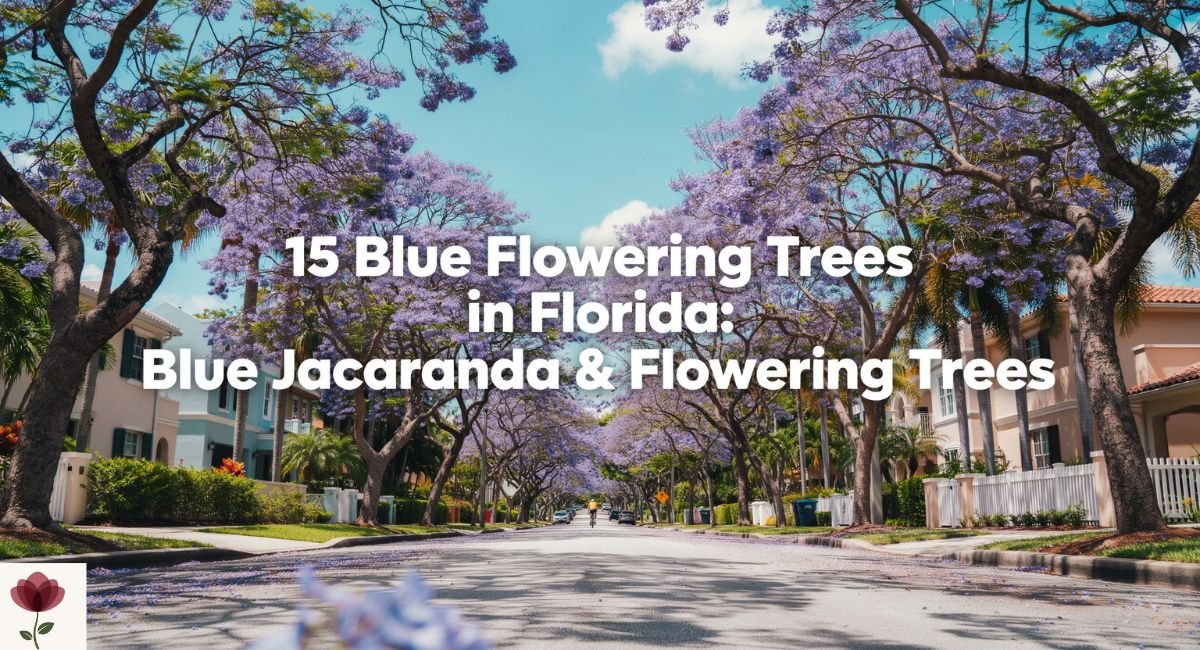
Florida’s warm climate creates the perfect backdrop for colorful flowering trees. Among them, blue flowering trees in Florida bring a cool, refreshing touch to sunny landscapes. Their blooms can range from soft lavender and violet-blue to rich blue-purple shades. The famous blue jacaranda is especially admired for its breathtaking spring display. However, it isn’t the only option worth exploring. Depending on your region, you can find blue flowering trees, small ornamental varieties, and tropical species suited to different garden conditions.
This guide explores 15 beautiful choices, including blue jacaranda, flowering trees, and other blue-toned ornamentals. You’ll also learn about bloom seasons, growing regions, mature sizes, and practical planting tips for Florida.
Blue Flowering Trees in Florida at a Glance
The table below gives you a quick comparison before you explore each species. Mature size can vary with cultivar, pruning, soil, rainfall, and local climate. Hardiness zones should guide your choice, but a site’s microclimate can also make a noticeable difference.
| Tree Name | Flower Color | Bloom Season | Mature Height | USDA Zones | Best Florida Region |
| Blue Jacaranda | Blue-purple | Spring | 30–50 ft | 9–11 | Central & South |
| Jacaranda Selections | Blue-purple | Spring | Varies | 9–11 | Central & South |
| Princess Tree | Lavender-blue | Spring | 30–50 ft | 5B–9B | Limited use |
| Blue Trumpet Tree | Blue-purple | Seasonal | Varies | Species dependent | Warm regions |
| Purple Orchid Tree | Purple-lavender | Fall | 30–35 ft | 9B–11 | Central & South |
| Hong Kong Orchid Tree | Purple-pink | Cool season | 20–40 ft | 9B–11 | Central & South |
| Blue Palo Verde | Blue-green foliage; yellow flowers | Spring | 15–30 ft | Species dependent | Dry sites |
| Desert Willow | Lavender-pink to purple | Summer | 15–30 ft | 7–11 | Selected sites |
| Vitex Tree | Lavender-blue | Summer | 8–20 ft | 6–10 | North & Central |
| Mexican Lilac | Blue-lavender | Seasonal | Varies | Warm zones | Central & South |
| Blue Butterfly Tree | Blue-violet | Warm season | Tree-form varies | 9–11 | South Florida |
| Lavender Trumpet Tree | Purple-blue | Seasonal | Varies | Warm zones | South Florida |
| Blue Lead Tree | Pale-toned flowers | Warm season | Varies | Warm zones | Limited use |
| Purple Tabebuia | Pink-purple | Spring | 20–40 ft | 9–11 | Central & South |
| Purple Glory Tree | Purple | Spring–fall | 15–20 ft | 10B–11 | South Florida |
What Are Blue Flowering Trees in Florida?
A blue flowering tree usually means a woody ornamental with flowers ranging from blue to lavender or violet. Botanically, those colors aren’t interchangeable. Many popular landscape trees marketed as blue actually have purple pigments. That distinction helps you set realistic expectations when choosing plants from photographs or nursery catalogs.
Florida’s heat can encourage rapid growth, yet growth alone doesn’t guarantee flowering. Most ornamentals need abundant sunlight, suitable drainage, adequate moisture, and enough space for their roots and canopy. Non-native species also require extra scrutiny because some plants can escape cultivation or become problematic in natural areas.
Where Do Blue Flowering Trees Grow Best in Florida?
Florida’s geography creates a surprisingly broad planting spectrum. A species that thrives near Miami may struggle after a hard freeze in Tallahassee. Likewise, a tree suited to sandy inland soil may dislike a poorly drained yard. Always consider USDA zones, exposure, drainage, and nearby structures together.
North Florida
North Florida has colder winters than the peninsula’s southern regions. Gardeners should therefore favor species with reliable cold tolerance or provide suitable protection for borderline plants. Chaste trees can tolerate colder conditions better than many tropical ornamentals, while frost-sensitive species may suffer serious dieback after freezing weather.
Central Florida
Central Florida offers a useful compromise for many ornamental trees. Warm summers support vigorous growth, while winter cold remains an important consideration. Well-drained sandy soil is common, although urban yards can have compacted areas. Full sun, sensible irrigation, and adequate root space usually improve landscape performance.
South Florida
South Florida supports many tropical and subtropical ornamentals that struggle farther north. Warm winters allow longer growing seasons and more reliable flowering. However, gardeners still need to consider hurricanes, salt exposure, wet-season rainfall, and saturated soil. A tropical climate doesn’t excuse poor site selection or weak tree structure.
15 Blue Flowering Trees in Florida
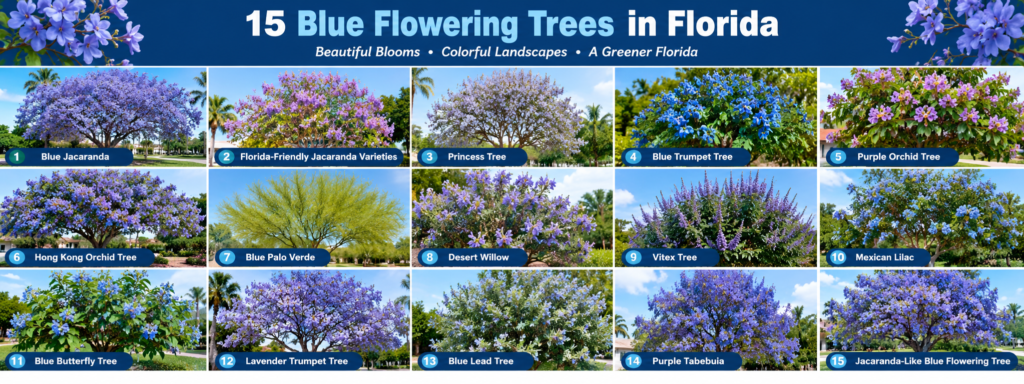
The following selections focus on trees and tree-form ornamentals with blue, lavender, violet, or blue-purple flowers. Some deserve special caution. Florida gardeners should check current UF/IFAS recommendations before planting non-native species because ecological status can vary by region.
1. Blue Jacaranda (Jacaranda mimosifolia)
Blue jacaranda remains the classic choice when gardeners picture a spectacular blue-purple canopy. Its trumpet-shaped flowers appear in abundant clusters, often creating a dramatic spring display. UF/IFAS notes that jacaranda prefers full sun and well-drained soils. It can also develop large surface roots, so give mature trees plenty of room.
Jacaranda works especially well as a specimen or broad street tree where overhead space is available. Its arching branches can create attractive filtered shade. However, flower and leaf drop can become messy near pools and high-use patios. Proper structural pruning also matters because poorly trained branches can create weak branch unions.
2. Florida-Friendly Jacaranda Varieties
Not every jacaranda planted in Florida grows exactly the same way. Cultivar selection can influence canopy form, mature size, and landscape behavior. When choosing a nursery tree, inspect the trunk structure carefully. A strong central trunk and well-spaced major branches can make future maintenance much easier.
For residential yards, think beyond the flowers. A young tree may look modest at the nursery while eventually becoming a substantial specimen. Keep buildings, sidewalks, pools, driveways, and utility lines in mind. Root space and canopy clearance should shape your decision before flower color does.
3. Princess Tree (Paulownia tomentosa)
Princess tree produces enormous heart-shaped leaves and clusters of lavender flowers before new foliage emerges. That timing creates an impressive spring display. However, this isn’t a carefree Florida recommendation. UF/IFAS identifies Paulownia tomentosa as a non-native invasive plant and does not recommend it for Florida.
The species can grow rapidly in suitable conditions and reach substantial dimensions. Its flowers can also be damaged by severe cold. Because ecological suitability matters as much as appearance, gardeners should treat this tree as an identification and comparison example rather than a routine Florida planting recommendation.
4. Blue Trumpet Tree
“Blue trumpet tree” can refer to different plants in horticultural trade, which makes the common name unreliable. Several trumpet-flowered tropical trees produce flowers in purple, lavender, or pink-purple shades rather than true blue. Always confirm the scientific name before purchasing one advertised under this label.
That small step prevents a surprisingly common gardening headache. The same common name may describe plants with different mature sizes, hardiness, and ecological behavior. Before planting, check the species’ Florida range, invasive assessment, sunlight requirements, and drainage needs. A photograph alone isn’t enough for accurate identification.
5. Purple Orchid Tree
Purple orchid tree (Bauhinia purpurea) produces large orchid-like flowers in purple, pink, and lavender tones. UF/IFAS describes it as a fast-growing tree that can reach roughly 35 feet. Its autumn flowering period can provide color when many spring bloomers have already finished.
Despite its beauty, this species deserves ecological caution in Florida. UF/IFAS has classified it as invasive and not recommended for Florida. Therefore, its striking flowers shouldn’t outweigh regional planting guidance. Native alternatives or approved Florida-friendly species may provide better long-term choices for many homeowners.
6. Hong Kong Orchid Tree
Hong Kong orchid tree is another tropical ornamental often associated with purple or pink flowers. Its broad leaves and rounded canopy give it a different silhouette from the airy jacaranda. The flowers can create strong seasonal color while the tree provides useful shade in warm landscapes.
Because common names can overlap among orchid trees, confirm the exact species before purchasing. Check its mature spread as carefully as its height. A tree planted too close to a structure can turn from a charming landscape accent into a pruning project surprisingly quickly.
7. Blue Palo Verde
Blue palo verde is unusual because its blue-green foliage contributes much of its blue visual character. Its flowers are generally yellow rather than blue. That makes it a poor choice if your goal is genuinely blue blossoms. Still, its unusual coloration can interest gardeners seeking a cooler-toned ornamental silhouette.
The bigger issue is climate fit. Palo verde species are associated with hot, relatively dry environments. Florida’s humidity, heavy summer rainfall, and wet soils create a different growing challenge. Excellent drainage becomes particularly important. In many Florida yards, better-adapted species make more practical landscape choices.
8. Desert Willow
Desert willow (Chilopsis linearis) produces attractive tubular flowers in shades that can include lavender and purple. Despite its name, it isn’t a true willow. Its narrow leaves and open habit give it a graceful appearance that works well in hot landscapes with adequate drainage.
Florida conditions can be challenging because the species evolved for much drier environments. Heavy rainfall and poorly drained soil can undermine its performance. If you try it, select a sunny site with excellent drainage. Treat it as a specialized ornamental rather than a universally suitable Florida tree.
9. Vitex Tree
Vitex, or chaste tree, offers spikes of lavender-blue flowers during warm weather. Its flowers create a softer display than jacaranda’s broad canopy of blooms. UF/IFAS notes that it tolerates heat well and performs in several soil types when drainage remains adequate.
Vitex also gives gardeners flexibility because it can grow as a shrub or be trained into a small tree. That makes it useful where space is limited. Its branching habit still needs attention, especially when you want a clear trunk. Regular structural pruning can help create a more deliberate form.
10. Mexican Lilac
Mexican lilac is commonly used as a small flowering landscape plant rather than a large canopy tree. Its blue-lavender flowers can create the color gardeners seek without requiring the footprint of a mature jacaranda. That compact character makes it attractive for smaller residential landscapes.
However, common names can create confusion because “Mexican lilac” may refer to different plants in different markets. Confirm the botanical identity before purchasing. Check mature height, growth habit, and Florida suitability first. If a seller cannot provide the scientific name, consider that a useful warning sign.
11. Blue Butterfly Tree
The blue butterfly tree is generally better understood as a tree-trained or large ornamental shrub rather than a conventional canopy tree. Its unusual blue-violet flowers are its main attraction. In warm climates, it can create a charming tropical effect around patios, courtyards, and garden entrances.
South Florida provides the warmth these plants generally prefer. However, their final form depends heavily on pruning and growing conditions. If you want a single-trunk specimen, training must begin early. Otherwise, the plant may naturally develop a broader, shrub-like habit rather than resembling a traditional flowering tree.
12. Lavender Trumpet Tree
Lavender trumpet tree is another common-name category that requires careful botanical identification. “Trumpet tree” can describe several unrelated species with different flower colors and climate requirements. Some produce lavender or purple flowers, while others display pink, white, or yellow blooms.
For that reason, don’t choose one solely because a nursery label promises blue flowers. Ask for the scientific name and mature dimensions. Then verify the plant against reliable Florida horticultural information. This simple habit helps you avoid purchasing a beautiful tree that later proves unsuitable for your region.
13. Blue Lead Tree
Blue lead tree is not a dependable category for a classic blue-flowering Florida specimen. Plants sold under similar common names can differ substantially in flower color and growth form. Some may be shrubs rather than trees. Therefore, identification should come before landscape planning.
If your goal is a dramatic blue floral canopy, jacaranda or a suitable tree-form ornamental usually provides a clearer match. For smaller spaces, however, blue-toned shrubs can offer similar visual interest. The key is matching the plant’s mature form with the job you want it to perform.
14. Purple Tabebuia
Purple tabebuia, often associated with Handroanthus species, produces vivid pink-purple flowers that can appear blue-purple from a distance. The flowers often become especially noticeable when the tree has limited foliage. That creates the almost painted appearance many Florida gardeners love.
Its warm-climate performance makes it more suitable for Central and South Florida than colder locations. Still, species and cultivar differences matter. Check the exact plant before purchase. Consider mature height, storm exposure, drainage, and available canopy space when selecting a specimen tree.
15. Purple Glory Tree
Purple glory tree (Tibouchina granulosa) is a genuine tree-form ornamental that deserves attention when discussing blue-toned flowering plants. UF/IFAS lists it as a tree reaching roughly 15 to 20 feet. Its flowers are purple, and flowering can occur across several seasons in suitable climates.
This species suits warm regions, especially South Florida and other areas within its hardiness range. It grows in full sun and tolerates several well-drained soil types. Its moderate size also makes it easier to fit into residential landscapes than many large flowering canopy trees.
How to Identify a Blue Flowering Tree in Florida
Flower color alone can mislead you. Many purple flowering trees look blue under certain lighting conditions. Instead, examine several traits together. Flower shape, leaf arrangement, bark, canopy structure, bloom season, and mature size create a much stronger identification pattern than color alone.
A good identification process also starts with the plant’s scientific name. Nursery tags, university extension resources, and reputable botanical databases can help confirm the species. When common names conflict, scientific names act like an address. They point you toward the exact plant rather than a loose family of similar-looking ornamentals.
Look at the Flower Shape
Trumpet-shaped flowers often point toward one group of ornamentals, while clustered spikes suggest another. Examine whether flowers hang individually, form dense clusters, or emerge from branch tips. Flower structure can remain useful even when sunlight changes the apparent color.
Check the Leaves
Leaves provide another excellent clue. Jacaranda has finely divided compound foliage, while many orchid trees have broad, two-lobed leaves. Evergreen and deciduous habits also help separate species. If flowers disappear between seasons, foliage can keep your identification process moving.
Consider the Blooming Season
Bloom timing can narrow your choices quickly. Jacaranda commonly creates its famous display during spring, while vitex flowers during warmer months. Orchid trees can flower during cooler portions of the year. Keep a simple garden calendar and record when each tree begins flowering.
Check Tree Size and Growth Habit
A mature tree’s shape can reveal more than a single flower. Look at trunk number, canopy width, branch angle, and overall height. A small multi-stemmed plant shouldn’t be mistaken for a future 40-foot specimen. Mature size also determines whether the tree belongs near your home.
Blue Flowering Trees vs. Purple Flowering Trees
Blue and purple flowers can be surprisingly difficult to separate in photographs. Camera settings, sunlight, soil conditions, and even the viewer’s screen can change perceived color. In practical gardening, it makes more sense to think in terms of a blue-to-purple spectrum rather than expecting every plant to deliver a pure blue bloom.
| Feature | Blue Flowering Trees | Purple Flowering Trees |
| Common shades | Blue, lavender, blue-purple | Purple, violet, pink-purple |
| Florida example | Blue Jacaranda | Purple Tabebuia |
| Visual character | Cool and airy | Deep and dramatic |
| Common confusion | May appear purple | May appear blue |
| Best identification clue | Flower plus foliage | Flower plus foliage |
When Do Blue Flowering Trees Bloom in Florida?
Flowering calendars vary across Florida because winter temperatures, rainfall, and local microclimates aren’t identical. A tree can bloom earlier in Miami than in North Florida. Bloom season should therefore be treated as a useful range rather than an exact appointment on your calendar.
Spring-Blooming Trees
Spring is the signature season for several spectacular ornamentals. Jacaranda can produce a dramatic display as temperatures rise. Other species may flower before or alongside new foliage. A warm spring can accelerate development, while unusual cold can delay or reduce the display.
Summer-Blooming Trees
Summer flowering adds color after many spring trees finish. Vitex can produce lavender-blue flower spikes during warm weather. Some tropical ornamentals also continue flowering when moisture and sunlight remain favorable. Regular watering helps newly planted trees, although mature drought-tolerant species shouldn’t be kept constantly wet.
Fall-Blooming Trees
Fall brings another useful flowering window for selected ornamentals. Purple orchid tree, for example, can flower from September into November. Cooler temperatures don’t automatically mean the landscape must become dull. Choosing trees with different bloom periods can create a longer sequence of seasonal color.
How to Grow Blue Flowering Trees in Florida
Successful flowering starts long before the first blossom appears. The right tree must match the site’s climate, soil, sunlight, drainage, and available space. Florida landscaping also demands attention to storm exposure. A beautiful tree with weak structure can become a serious maintenance problem during hurricane season.
Choose the Right Location
Full sun generally produces stronger flowering for many ornamental trees. Give the tree enough room to develop without rubbing against roofs, walls, sidewalks, or utility lines. Consider the mature canopy rather than the nursery size. A small sapling is only the opening chapter of the story.
Prepare the Soil
Florida soils often contain substantial sand, while urban sites may have compacted fill or construction debris. Drainage therefore deserves careful attention. Many ornamentals tolerate different soil textures as long as excess water can move away from the root zone. Avoid creating a permanently soggy planting pocket.
Water Properly
New trees need consistent establishment watering while their root systems develop. Mature trees often need less frequent irrigation once established. During Florida’s rainy season, natural rainfall may supply plenty of moisture. Overwatering can be just as damaging as drought, particularly for species that dislike saturated roots.
Prune at the Right Time
Pruning should improve structure rather than simply make a tree smaller. Remove damaged or poorly attached branches and develop strong branch spacing while the tree is young. Jacaranda deserves particular attention because UF/IFAS notes that poorly trained branches can split. Structural pruning is an investment in future stability.
Are Blue Flowering Trees Native to Florida?
Not all colorful flowering trees belong naturally to Florida. Some are introduced ornamentals that gardeners value for flowers, shade, or tropical character. Others may pose ecological concerns. UF/IFAS assessments identify several non-native flowering trees as invasive or inappropriate for Florida landscapes, so appearance alone shouldn’t determine your choice.
Native status also affects wildlife relationships. A native tree may support local insects, birds, and other organisms that evolved alongside it. That doesn’t mean every introduced tree is harmful. Instead, gardeners should evaluate ecological impact, regional recommendations, maintenance, and escape potential before adding an unfamiliar ornamental.
Are Blue Jacaranda Trees Good for Florida Landscapes?
Jacaranda can be an excellent ornamental subject when its site requirements match the landscape. It prefers full sun, tolerates well-drained sandy soils, and can provide attractive filtered shade. UF/IFAS also notes that its abundant leaf and flower drop can make it unsuitable beside pools or other high-use areas.
Space is the main consideration. Jacaranda can become a substantial tree with spreading branches and surface roots. Give it adequate room from pavement and structures. Good structural pruning also matters. With proper placement and training, it can become a memorable specimen tree rather than a recurring maintenance headache.
Common Problems With Blue Flowering Trees in Florida
The most common problem isn’t always a disease. Poor site selection can create bigger trouble. Saturated roots, inadequate sunlight, restricted root space, cold exposure, weak branch unions, and excessive irrigation can all reduce tree health. Florida’s intense storms add another layer of risk for poorly structured trees.
Flowering problems also have several causes. A tree may receive too much shade, suffer drought stress, receive excessive nitrogen, or simply be too young to flower heavily. Before reaching for fertilizer, examine the basics. Sunlight, drainage, water management, and pruning often explain more than a missing nutrient.
How to Choose the Best Blue Flowering Tree for Your Florida Yard
Start with your region rather than the flower photograph. North, Central, and South Florida have different winter risks and growing conditions. Then consider mature height, canopy width, drainage, sunlight, wind exposure, and maintenance. A plant that fits the site usually needs less corrective care later.
Next, verify the scientific name and current Florida recommendations. This step becomes especially important with non-native ornamentals and confusing common names. Think about the entire life of the tree, not just its first spectacular bloom. Right tree, right place remains one of the simplest rules in landscape design.
Conclusion
A blue-toned flowering tree can transform an ordinary Florida yard into something memorable. The choices range from towering jacarandas to smaller tree-form ornamentals with lavender or purple blooms. Yet flower color should never be the only deciding factor. Climate, mature size, drainage, sunlight, structure, and ecological suitability all deserve equal attention.
For many warm Florida landscapes, jacaranda remains a striking centerpiece. Other choices can provide smaller canopies or different flowering seasons. The smartest approach is simple: identify the exact species, check its Florida suitability, and plant it where its mature form has room to thrive. That way, your garden gets lasting color rather than a short-lived show.
FAQs
What is the most popular blue flowering tree in Florida?
Blue jacaranda is one of the best-known choices because its large canopy can become covered with blue-purple flowers during its main flowering period.
What tree has blue flowers in Florida?
Several ornamentals produce blue, lavender, or blue-purple blooms. Jacaranda is the most recognizable example, while vitex and some tree-form ornamentals provide similar cool-toned flowers.
Do blue jacaranda trees grow well in Florida?
Jacaranda performs best in warm Florida regions with full sun and well-drained soil. Give it generous canopy and root space before planting.
What month does jacaranda bloom in Florida?
Jacaranda generally flowers during spring. Exact timing varies with temperature, location, tree age, and growing conditions across different parts of Florida.
Can blue flowering trees grow in North Florida?
Some can tolerate North Florida, but tropical species may suffer freeze damage. Always check hardiness and regional suitability before planting a sensitive ornamental.

Welcome to PetalNexa! I’m Anam Sattar, an AI-powered SEO Specialist and Content Writer with over 4 years of experience in creating high-quality, search-optimized content. I help businesses improve their search engine rankings, increase organic traffic, and build beautiful, user-friendly websites. My mission is to make SEO, content creation, and web design simple, effective, and accessible for everyone. Let’s grow your online presence and achieve success together!
2 thoughts on “15 Blue Flowering Trees in Florida: Blue Jacaranda & Flowering Trees”