

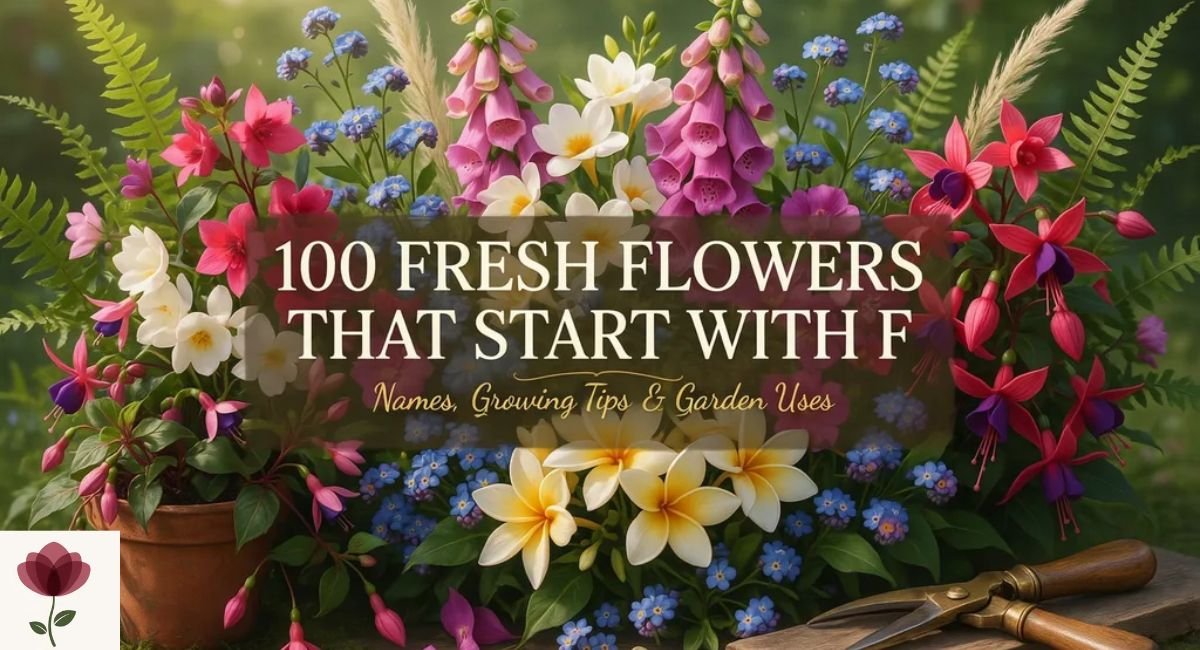
Flowers That Start With F bring together some of the most colorful, fragrant, and fascinating blooms you can grow. From the graceful Freesia to the eye-catching Foxglove and tropical Fuchsia, these flowers suit every garden style and skill level. Whether you’re searching for common flowers that start with F, unique flowering plants that start with F, or easy types of flowers that start with F, this guide has everything in one place.
You’ll discover 100 remarkable varieties, learn their names, growing requirements, garden uses, and symbolic meanings. By the end, you’ll have the confidence to choose the perfect F flowers that thrive in your climate and add lasting beauty to your landscape with ease.
What Are Flowers That Start With F?
Flowers That Start With F are flowering plants whose common names begin with the letter F. This diverse collection includes cheerful garden annuals, long-lasting perennials, fragrant bulbs, elegant orchids, flowering shrubs, ornamental trees, climbing plants, and tropical houseplants. Some, like Freesia and Forget-Me-Not, are loved worldwide for their beauty and fragrance. Others, such as Fairy Slipper Orchid or Fritillaria, attract gardeners looking for something more unusual. Together, these flowering plants that start with F create one of the most diverse groups found in any alphabetical flower guide.
Their popularity comes from far more than colorful blooms. Many F flowers bloom for months, attract butterflies, hummingbirds, and bees, or fill the air with a pleasant fragrance. Others stand out because of their unique flower shapes, brilliant foliage, or rich symbolism. In this guide, you’ll explore Flowers That Start With F through detailed plant profiles, color collections, growing categories, gardening tips, and practical recommendations for every landscape. Whether you’re a beginner or an experienced gardener, you’ll find valuable inspiration to help you choose the perfect flowers for your outdoor or indoor space.
Complete List of 100 Flowers That Start With F
If you’re searching for the most complete collection of Flowers That Start With F, you’ve come to the right place. This carefully researched table brings together 100 unique flower names that begin with the letter F. It includes well-known garden favorites, charming flowering plants that start with F, colorful wildflowers, ornamental shrubs, elegant trees, and rare botanical treasures. Whether you’re a beginner gardener, a flower enthusiast, or simply exploring types of flowers that start with F, this quick reference makes identification simple and enjoyable.
The table below provides each flower’s common name, botanical name, main flower color, and plant type. It offers a fast overview before the detailed descriptions later in this guide, helping you compare common flowers that start with F and discover new varieties for landscapes, containers, pollinator gardens, woodland borders, or indoor displays.
| No. | Common Name | Botanical Name | Flower Color | Plant Type |
| 1 | Fairy Bell | Disporum spp. | White, Cream | Perennial |
| 2 | Fairy Duster | Calliandra eriophylla | Pink, Red | Shrub |
| 3 | Fairy Iris | Dietes spp. | White, Yellow | Perennial |
| 4 | Fairy Lantern | Calochortus spp. | Pink, White | Bulb |
| 5 | Fairy Primrose | Primula malacoides | Pink, White | Perennial |
| 6 | Fairy Slipper Orchid | Calypso bulbosa | Pink, Purple | Orchid |
| 7 | Fairy Thimbles | Campanula cochleariifolia | Blue, White | Perennial |
| 8 | False Aster | Boltonia asteroides | White | Perennial |
| 9 | False Bird of Paradise | Heliconia spp. | Red, Orange | Tropical Perennial |
| 10 | False Dragonhead | Physostegia virginiana | Pink, Purple | Perennial |
| 11 | False Forget-Me-Not | Brunnera macrophylla | Blue | Perennial |
| 12 | False Goat’s Beard | Astilbe spp. | Pink, White | Perennial |
| 13 | False Hellebore | Veratrum spp. | Green, White | Perennial |
| 14 | False Indigo | Baptisia spp. | Blue | Perennial |
| 15 | False Lily of the Valley | Maianthemum spp. | White | Woodland Perennial |
| 16 | False Lupine | Thermopsis spp. | Yellow | Perennial |
| 17 | False Mallow | Malvastrum spp. | Orange, Pink | Annual / Perennial |
| 18 | False Mitrewort | Tiarella trifoliata | White | Woodland Perennial |
| 19 | False Queen Anne’s Lace | Ammi majus | White | Annual |
| 20 | False Rue Anemone | Enemion biternatum | White | Wildflower |
| 21 | False Solomon’s Seal | Maianthemum racemosum | White | Perennial |
| 22 | False Spirea | Sorbaria sorbifolia | White | Shrub |
| 23 | False Sunflower | Heliopsis helianthoides | Yellow | Perennial |
| 24 | Fan Columbine | Aquilegia flabellata | Blue, White | Perennial |
| 25 | Fan Flower | Scaevola aemula | Blue, Purple | Annual |
| 26 | Farewell-to-Spring | Clarkia amoena | Pink | Annual |
| 27 | Fawn Lily | Erythronium spp. | Yellow | Bulb |
| 28 | Feather Celosia | Celosia argentea var. plumosa | Red, Yellow | Annual |
| 29 | Feather Hyacinth | Muscari comosum | Purple | Bulb |
| 30 | Fernleaf Bleeding Heart | Dicentra eximia | Pink | Perennial |
| 31 | Fernleaf Peony | Paeonia tenuifolia | Red | Perennial |
| 32 | Fernleaf Yarrow | Achillea filipendulina | Yellow | Perennial |
| 33 | Feverfew | Tanacetum parthenium | White | Perennial |
| 34 | Fiddlewood | Citharexylum spinosum | White | Flowering Tree |
| 35 | Field Bindweed | Convolvulus arvensis | White, Pink | Vine |
| 36 | Field Scabious | Knautia arvensis | Lavender | Wildflower |
| 37 | Fig Marigold | Carpobrotus spp. | Pink | Succulent |
| 38 | Fire Lily | Gloriosa superba | Red, Yellow | Climber |
| 39 | Fire Pink | Silene virginica | Red | Wildflower |
| 40 | Firecracker Flower | Crossandra infundibuliformis | Orange | Tropical Plant |
| 41 | Firecracker Penstemon | Penstemon eatonii | Red | Perennial |
| 42 | Firecracker Plant | Russelia equisetiformis | Red | Shrub |
| 43 | Firethorn | Pyracantha spp. | White | Shrub |
| 44 | Fireweed | Chamerion angustifolium | Pink | Wildflower |
| 45 | Firewheel | Gaillardia pulchella | Red, Yellow | Annual |
| 46 | Fishbone Cactus | Disocactus anguliger | White | Cactus |
| 47 | Five Spot Flower | Nemophila maculata | White, Purple | Annual |
| 48 | Flanders Poppy | Papaver rhoeas | Red | Annual |
| 49 | Flag Iris | Iris spp. | Blue, Purple | Perennial |
| 50 | Flame Azalea | Rhododendron calendulaceum | Orange | Shrub |
| 51 | Flame Flower | Talinum calycinum | Pink | Perennial |
| 52 | Flame Violet | Episcia cupreata | Red | Indoor Plant |
| 53 | Flaming Katy | Kalanchoe blossfeldiana | Red, Pink | Succulent |
| 54 | Flamingo Flower | Anthurium andraeanum | Red | Houseplant |
| 55 | Flannel Bush | Fremontodendron spp. | Yellow | Shrub |
| 56 | Flannel Flower | Actinotus helianthi | White | Perennial |
| 57 | Flax Flower | Linum perenne | Blue | Perennial |
| 58 | Flax Lily | Dianella spp. | Blue | Perennial |
| 59 | Fleabane | Erigeron spp. | White, Pink | Perennial |
| 60 | Floating Heart | Nymphoides spp. | Yellow | Aquatic Plant |
| 61 | Floribunda Rose | Rosa Floribunda Group | Various | Shrub Rose |
| 62 | Floss Flower | Ageratum houstonianum | Blue | Annual |
| 63 | Flowering Almond | Prunus glandulosa | Pink | Shrub |
| 64 | Flowering Cherry | Prunus spp. | Pink | Tree |
| 65 | Flowering Crabapple | Malus spp. | Pink, White | Tree |
| 66 | Flowering Currant | Ribes sanguineum | Pink | Shrub |
| 67 | Flowering Dogwood | Cornus florida | White | Tree |
| 68 | Flowering Maple | Abutilon spp. | Orange | Shrub |
| 69 | Flowering Quince | Chaenomeles spp. | Red | Shrub |
| 70 | Flowering Raspberry | Rubus odoratus | Purple | Shrub |
| 71 | Flowering Tobacco | Nicotiana alata | White | Annual |
| 72 | Foamflower | Tiarella cordifolia | White | Perennial |
| 73 | Foothill Penstemon | Penstemon heterophyllus | Blue | Perennial |
| 74 | Forget-Me-Not | Myosotis spp. | Blue | Biennial |
| 75 | Forked Bluecurls | Trichostema dichotomum | Blue | Annual |
| 76 | Forsythia | Forsythia spp. | Yellow | Shrub |
| 77 | Four O’Clock | Mirabilis jalapa | Pink | Perennial |
| 78 | Foxglove | Digitalis purpurea | Purple | Biennial |
| 79 | Foxtail Lily | Eremurus spp. | White | Bulb |
| 80 | Fragrant Gladiolus | Gladiolus murielae | White | Bulb |
| 81 | Fragrant Orchid | Gymnadenia conopsea | Pink | Orchid |
| 82 | Frangipani | Plumeria spp. | White, Yellow | Tree |
| 83 | Freesia | Freesia spp. | Mixed Colors | Bulb |
| 84 | French Lavender | Lavandula dentata | Purple | Shrub |
| 85 | French Marigold | Tagetes patula | Yellow, Orange | Annual |
| 86 | Fringe Flower | Loropetalum chinense | Pink | Shrub |
| 87 | Fringe Tree | Chionanthus virginicus | White | Tree |
| 88 | Fringecups | Tellima grandiflora | Cream | Perennial |
| 89 | Frogfruit | Phyla nodiflora | White | Groundcover |
| 90 | Frost Aster | Symphyotrichum pilosum | White | Perennial |
| 91 | Frostflower | Verbesina virginica | White | Wildflower |
| 92 | Fritillaria | Fritillaria spp. | Purple | Bulb |
| 93 | Fumewort | Corydalis solida | Pink | Perennial |
| 94 | Fuchsia | Fuchsia spp. | Pink, Purple | Shrub |
| 95 | Fuzzy Deutzia | Deutzia scabra | White | Shrub |
| 96 | Florida Anise | Illicium floridanum | Maroon | Shrub |
| 97 | Forest Lily | Veltheimia bracteata | Pink | Bulb |
| 98 | Forest Bellflower | Campanula latifolia | Violet | Perennial |
| 99 | Fairy Wand | Chasmanthe floribunda | Orange | Bulb |
| 100 | Feather Bush | Adenanthos sericeus | Red | Flowering Shrub |
Flowers That Start With F Explained
The list below highlights twenty of the most admired Flowers That Start With F. Each flower has its own beauty, growing needs, and special purpose in the garden. Some produce fragrant blooms that brighten bouquets, while others attract butterflies, hummingbirds, and helpful pollinators. You’ll also discover several common flowers that start with F alongside unique flowering plants that start with F that deserve more attention from gardeners.
Freesia

Scientific Name: Freesia spp.
Plant Type: Corm Perennial
Flower Color: White, Yellow, Pink, Purple, Red, Orange
Bloom Season: Spring
USDA Zones: 9–10
Sunlight Needs: Full Sun
Mature Size: 12–18 inches
Freesia is one of the most loved Flowers That Start With F because of its elegant trumpet-shaped blooms and unforgettable fragrance. Native to South Africa, it has become a favorite in American gardens, wedding bouquets, and floral arrangements. Its sweet scent often fills an entire room, making it one of the finest cut flowers you can grow.
The flower represents friendship, trust, and new beginnings. Plant the corms in well-drained soil where they receive plenty of sunshine. Regular watering during active growth encourages stronger stems and more colorful flowers, but avoid soggy soil because the corms may rot.
Fuchsia

Scientific Name: Fuchsia spp.
Plant Type: Tender Perennial Shrub
Flower Color: Pink, Purple, Red, White
Bloom Season: Summer to Fall
USDA Zones: 8–10
Sunlight Needs: Partial Shade
Mature Size: 1–6 feet
Fuchsia is famous for its graceful hanging flowers that resemble tiny dancing lanterns. Its bright two-tone blossoms make it one of the most attractive flowering plants that start with F, especially for hanging baskets and shaded patios. The plant blooms continuously through the warmer months when properly cared for.
This flower symbolizes elegance, confidence, and graceful beauty. Fuchsia grows best in cool conditions with moist but well-drained soil. During hot summers, afternoon shade helps protect the delicate blooms and keeps the plant flowering much longer.
Foxglove

Scientific Name: Digitalis purpurea
Plant Type: Biennial
Flower Color: Purple, Pink, White, Yellow
Bloom Season: Late Spring to Early Summer
USDA Zones: 4–9
Sunlight Needs: Full Sun to Partial Shade
Mature Size: 2–6 feet
Foxglove stands tall with dramatic spikes covered in bell-shaped flowers. It brings instant height and elegance to cottage gardens while attracting hummingbirds and bees throughout the blooming season. Among Flowers That Start With F, it remains one of the most recognizable garden classics.
Foxglove represents creativity, confidence, and protection. Although its flowers are stunning, every part of the plant is poisonous if eaten. Grow it in fertile soil with consistent moisture and remove faded flower spikes to encourage healthy growth.
Forget-Me-Not

Scientific Name: Myosotis spp.
Plant Type: Biennial or Short-Lived Perennial
Flower Color: Blue, Pink, White
Bloom Season: Spring
USDA Zones: 3–8
Sunlight Needs: Partial Shade
Mature Size: 6–12 inches
Forget-Me-Not produces hundreds of tiny sky-blue flowers that create a beautiful carpet in woodland gardens and shaded borders. Despite its delicate appearance, this charming plant spreads easily and returns year after year in suitable conditions.
The flower symbolizes remembrance, faithful love, and lasting friendship. It grows best in cool weather with moist soil rich in organic matter. Allow a few flowers to produce seeds if you want natural blooms the following spring.
Forsythia

Scientific Name: Forsythia spp.
Plant Type: Flowering Shrub
Flower Color: Bright Yellow
Bloom Season: Early Spring
USDA Zones: 5–8
Sunlight Needs: Full Sun
Mature Size: 6–10 feet
Forsythia is often the first sign that winter has ended. Before its leaves appear, every branch becomes covered with brilliant golden flowers that brighten gardens across the United States. Few Flowers That Start With F create such an impressive early-season display.
Forsythia symbolizes hope, happiness, and fresh beginnings. Prune the shrub immediately after flowering because next year’s flower buds develop during summer. A sunny location helps produce the richest spring color.
French Marigold

Scientific Name: Tagetes patula
Plant Type: Annual
Flower Color: Yellow, Orange, Red
Bloom Season: Summer to Frost
USDA Zones: Annual
Sunlight Needs: Full Sun
Mature Size: 8–18 inches
French Marigold is one of the easiest common flowers that start with F for beginners. Its cheerful blooms continue for months, adding bright color to flower beds, borders, and containers while naturally helping to discourage some garden pests.
This flower represents warmth, creativity, and positive energy. Remove faded blooms regularly to encourage continuous flowering. Rich sunshine and moderate watering keep the plants healthy throughout the growing season.
Floss Flower

Scientific Name: Ageratum houstonianum
Plant Type: Annual
Flower Color: Blue, Lavender, Pink, White
Bloom Season: Summer to Fall
USDA Zones: Annual
Sunlight Needs: Full Sun
Mature Size: 6–24 inches
Floss Flower is admired for its soft, fuzzy flower heads that resemble tiny powder puffs. Its long-lasting blooms provide beautiful edging in flower beds while attracting butterflies throughout the summer.
The flower represents patience and lasting affection. It prefers fertile, well-drained soil and regular watering. Deadheading faded flowers encourages fresh blooms and keeps plants looking tidy.
Fan Flower

Scientific Name: Scaevola aemula
Plant Type: Tender Perennial
Flower Color: Blue, Purple, Pink, White
Bloom Season: Spring to Fall
USDA Zones: 10–11
Sunlight Needs: Full Sun
Mature Size: 8–18 inches
Fan Flower earns its name from its unusual fan-shaped petals that spread outward in a unique pattern. It performs exceptionally well in hanging baskets, window boxes, and containers because of its trailing growth habit and nonstop blooming.
Fan Flower symbolizes resilience and adaptability. It tolerates heat surprisingly well and requires little maintenance once established. Good drainage is essential for healthy roots and continuous flowering.
Frangipani

Scientific Name: Plumeria spp.
Plant Type: Flowering Tree
Flower Color: White, Yellow, Pink, Red
Bloom Season: Summer
USDA Zones: 10–12
Sunlight Needs: Full Sun
Mature Size: 15–25 feet
Frangipani is famous for its intensely fragrant tropical flowers that are often used in Hawaiian leis. The waxy blossoms bloom in clusters and create an unforgettable display that fills warm gardens with sweet perfume.
The flower symbolizes love, beauty, and new beginnings. Plant it in sunny locations with excellent drainage. In cooler parts of the USA, many gardeners successfully grow Frangipani in containers that can be moved indoors during winter.
Feverfew

Scientific Name: Tanacetum parthenium
Plant Type: Short-Lived Perennial
Flower Color: White with Yellow Centers
Bloom Season: Summer
USDA Zones: 5–9
Sunlight Needs: Full Sun
Mature Size: 18–24 inches
Feverfew produces masses of cheerful daisy-like flowers that brighten cottage gardens for weeks. Besides its ornamental value, this herb has been grown for centuries in traditional gardens because of its long history in herbal practices.
Feverfew symbolizes healing, resilience, and good health. It grows easily in well-drained soil and full sunshine. Trimming faded flowers encourages fresh blooms while preventing unwanted self-seeding in the garden.
Fritillaria

Scientific Name: Fritillaria spp.
Plant Type: Bulb Perennial
Flower Color: Purple, Yellow, Orange, White
Bloom Season: Spring
USDA Zones: 4–8
Sunlight Needs: Full Sun to Partial Shade
Mature Size: 12–48 inches
Fritillaria stands out because of its unusual bell-shaped flowers that often display beautiful checkered patterns. Some varieties grow tall enough to become the centerpiece of spring gardens, while smaller species blend perfectly into rock gardens and borders. Among Flowers That Start With F, it is one of the most eye-catching spring bulbs.
The flower symbolizes dignity, grace, and perseverance. Plant bulbs in rich, well-drained soil during autumn. Avoid overwatering during dormancy because excessive moisture can damage the bulbs before the next blooming season.
Foamflower

Scientific Name: Tiarella cordifolia
Plant Type: Perennial
Flower Color: White, Pale Pink
Bloom Season: Spring
USDA Zones: 3–9
Sunlight Needs: Partial to Full Shade
Mature Size: 8–12 inches
Foamflower produces delicate clusters of tiny blossoms that resemble soft clouds floating above attractive green leaves. It naturally spreads across woodland gardens and shaded landscapes, creating a peaceful and elegant appearance throughout spring.
Foamflower represents purity and quiet beauty. It thrives in moist, humus-rich soil with plenty of organic matter. Once established, it forms an attractive ground cover that requires very little maintenance.
Fire Lily

Scientific Name: Gloriosa superba
Plant Type: Climbing Perennial
Flower Color: Red and Yellow
Bloom Season: Summer
USDA Zones: 8–10
Sunlight Needs: Full Sun
Mature Size: 4–8 feet
Fire Lily is famous for its dramatic flame-like petals that curl backward as they mature. Its exotic appearance instantly captures attention, making it one of the most striking Flowers That Start With F for trellises and decorative supports.
This flower symbolizes passion, courage, and success. Provide a climbing structure and fertile soil for healthy growth. Although beautiful, every part of the plant is poisonous, so keep it away from children and pets.
Fire Pink

Scientific Name: Silene virginica
Plant Type: Native Perennial
Flower Color: Bright Red
Bloom Season: Spring to Early Summer
USDA Zones: 4–8
Sunlight Needs: Full Sun to Partial Shade
Mature Size: 12–18 inches
Fire Pink produces brilliant scarlet flowers that naturally attract hummingbirds throughout the blooming season. Native to eastern North America, it performs beautifully in woodland gardens and natural landscapes while supporting local wildlife.
The flower symbolizes energy, strength, and vitality. Grow it in well-drained soil with moderate watering. Avoid heavy clay because the roots prefer lighter soils with good drainage.
Four O’Clock

Scientific Name: Mirabilis jalapa
Plant Type: Tender Perennial
Flower Color: Pink, Yellow, White, Red, Mixed
Bloom Season: Summer to Fall
USDA Zones: 7–10
Sunlight Needs: Full Sun
Mature Size: 2–4 feet
Four O’Clock gets its unusual name because its fragrant flowers usually open during the late afternoon and remain open through the evening. The colorful blooms often appear in several shades on the same plant, creating a lively display.
This flower represents joy, surprise, and lasting friendship. It grows quickly from seed and tolerates heat well. Regular watering during dry periods keeps blooming strong until autumn.
Flamingo Flower

Scientific Name: Anthurium andraeanum
Plant Type: Tropical Houseplant
Flower Color: Red, Pink, White
Bloom Season: Year-Round Indoors
USDA Zones: 11–12
Sunlight Needs: Bright Indirect Light
Mature Size: 12–24 inches
Flamingo Flower is admired for its glossy heart-shaped blooms and deep green foliage. It remains one of the most popular flowering plants that start with F for indoor spaces because it flowers repeatedly with proper care.
The plant symbolizes hospitality, abundance, and happiness. Maintain slightly moist soil and high humidity to encourage healthy growth. Keep the plant away from direct afternoon sunlight to prevent leaf damage.
Flannel Flower

Scientific Name: Actinotus helianthi
Plant Type: Perennial
Flower Color: White
Bloom Season: Spring to Summer
USDA Zones: 9–11
Sunlight Needs: Full Sun
Mature Size: 12–24 inches
Flannel Flower produces soft, velvety petals that feel almost like fabric. Its elegant white blooms pair beautifully with native grasses and wildflowers, adding a natural look to modern landscapes.
The flower represents gentleness and sincerity. Excellent drainage is the key to success because overly wet soil can weaken the roots. Light pruning after flowering encourages fresh growth.
Fleabane

Scientific Name: Erigeron spp.
Plant Type: Perennial
Flower Color: White, Pink, Purple
Bloom Season: Spring to Summer
USDA Zones: 3–8
Sunlight Needs: Full Sun
Mature Size: 6–24 inches
Fleabane creates cheerful daisy-like flowers that brighten rock gardens, borders, and meadows. The long flowering period and ability to attract butterflies make it one of the most valuable common flowers that start with F for wildlife gardens.
The flower symbolizes endurance and simplicity. Fleabane adapts well to poor soils and dry conditions once established. Removing faded blooms helps extend the flowering season.
Foxtail Lily

Scientific Name: Eremurus spp.
Plant Type: Bulb Perennial
Flower Color: White, Yellow, Pink, Orange
Bloom Season: Late Spring to Early Summer
USDA Zones: 5–8
Sunlight Needs: Full Sun
Mature Size: 4–8 feet
Foxtail Lily develops towering flower spikes covered with hundreds of tiny blossoms. Its dramatic height creates a spectacular focal point in large flower beds and mixed borders while attracting bees and other pollinators.
This flower symbolizes ambition and achievement. Plant the roots carefully in loose, sandy soil with excellent drainage. Choose a sheltered location because tall flower spikes may bend in strong winds.
Flowering Dogwood

Scientific Name: Cornus florida
Plant Type: Flowering Tree
Flower Color: White, Pink
Bloom Season: Spring
USDA Zones: 5–9
Sunlight Needs: Full Sun to Partial Shade
Mature Size: 15–30 feet
Flowering Dogwood is one of the most beloved ornamental trees in North America. During spring, its graceful branches become covered with elegant blossoms before the leaves fully emerge. The tree also offers colorful berries and brilliant autumn foliage, providing beauty throughout multiple seasons.
Flowering Dogwood symbolizes renewal, hope, and enduring strength. Plant it in fertile, well-drained soil with consistent moisture. Applying mulch around the base helps protect shallow roots and supports healthy long-term growth.
How to Choose the Right F Flower for Your Garden

Choosing the perfect Flowers That Start With F depends on your climate, available space, sunlight, and gardening experience. Some flowers bloom for months with very little care, while others reward patient gardeners with rare beauty and fragrance. Before planting, consider your USDA hardiness zone, soil drainage, watering routine, and the amount of sunlight your garden receives. Matching the right plant to the right location helps flowers stay healthier and bloom more reliably.
You should also think about your garden’s purpose. If you want colorful borders, long-lasting bouquets, pollinator-friendly beds, or low-maintenance landscaping, there is an ideal option waiting for you. Many flowering plants that start with F adapt well to containers, while others perform best in large flower beds or woodland settings. The guide below will help you choose the varieties that suit your gardening goals.
Best Flowers for Beginners
If you’re new to gardening, start with flowers that forgive small mistakes and bloom without demanding constant attention. French Marigold, Forget-Me-Not, Floss Flower, and Four O’Clock are excellent beginner-friendly choices because they grow quickly, flower generously, and require only basic care. These common flowers that start with F are ideal for learning essential gardening skills while enjoying beautiful results.
Fast-Growing Flowers
Some gardeners want quick color instead of waiting several seasons. Four O’Clock, French Marigold, Floss Flower, Fan Flower, and Farewell-to-Spring grow rapidly from seed or young plants. Their fast growth makes them perfect for filling empty spaces, refreshing flower beds, or creating colorful summer displays in a short time.
Long-Blooming Flowers
A long flowering season means your garden stays attractive for months instead of weeks. Fuchsia, Fan Flower, French Marigold, Flamingo Flower, and Floss Flower continue blooming from spring through autumn with proper care. Removing faded flowers and watering consistently encourages these Flowers That Start With F to produce fresh blooms throughout the growing season.
Low-Maintenance Choices
Busy gardeners often prefer plants that stay healthy without constant pruning or watering. Forsythia, Fleabane, Foamflower, Fire Pink, and False Indigo tolerate different weather conditions while requiring minimal maintenance. Once established, these dependable plants return each year and reward you with reliable seasonal color.
Best Flowers for Small Spaces
Limited space doesn’t mean you have to sacrifice beauty. Compact Flowers That Start With F such as Freesia, Floss Flower, Fan Flower, Flamingo Flower, and Forget-Me-Not thrive in containers, window boxes, balconies, and small patios. Their manageable size makes them perfect for urban gardens while still providing vibrant blooms and attractive foliage.
Explore Flowers That Start With F by Category

Grouping Flowers That Start With F by plant type makes choosing the right variety much easier. Some flowers complete their life cycle within a single season, while others return year after year. You’ll also find climbing plants, flowering shrubs, ornamental trees, bulbs, woodland species, and beautiful indoor plants. Understanding these categories helps you build a balanced garden that offers color and interest throughout the year.
Whether you are designing a cottage garden, a modern landscape, or a wildlife-friendly backyard, selecting plants from different categories creates variety and extends the blooming season. The following groups highlight some of the best types of flowers that start with F for every style of garden.
Annual Flowers
Annual flowers complete their entire life cycle in one growing season but reward gardeners with nonstop blooms. French Marigold, Floss Flower, Farewell-to-Spring, Five Spot Flower, and Firewheel provide brilliant summer color and are perfect for borders, containers, and seasonal flower beds.
Perennial Flowers
Perennials return every year, making them an excellent long-term investment. Freesia, Foamflower, Fire Pink, Fritillaria, Fleabane, and False Indigo develop stronger root systems over time and often produce even better flowering displays after their first season.
Bulb Flowers
Bulb flowers store energy underground before producing spectacular seasonal blooms. Freesia, Fawn Lily, Foxtail Lily, Fritillaria, Fragrant Gladiolus, and Forest Lily create colourful spring and summer displays while remaining easy to divide and replant.
Wildflowers
Wildflowers naturally support local ecosystems while requiring very little maintenance. Fire Pink, Fleabane, Field Scabious, False Rue Anemone, and Frostflower attract butterflies, bees, and native pollinators while adding a relaxed, natural appearance to gardens and meadows.
Climbing Flowers
Climbing flowers transform fences, pergolas, and trellises into colourful living displays. Fire Lily, Field Bindweed, and several climbing Fuchsia varieties produce striking blooms while making excellent use of vertical garden space.
Shrubs
Flowering shrubs provide lasting structure as well as colourful seasonal blooms. Forsythia, Flowering Quince, Fringe Flower, False Spirea, Firethorn, and Floribunda Rose offer beautiful flowers, attractive foliage, and in many cases colourful berries or autumn interest.
Flowering Trees
Flowering trees become stunning focal points in any landscape. Flowering Dogwood, Flowering Cherry, Frangipani, Flowering Crabapple, Fringe Tree, and Fiddlewood provide beautiful blossoms during spring or summer while also offering shade and seasonal beauty.
Indoor Flowering Plants
Indoor flowering plants bring colour and freshness into your home throughout the year. Flamingo Flower, Flame Violet, Flaming Katy, Fishbone Cactus, and container-grown Fuchsia thrive indoors with bright indirect light, making them excellent choices for homes, offices, and apartments.
Flowers That Start With F by Flower Color

Flower color can completely change the mood of a garden. Some shades create a peaceful atmosphere, while others bring bold energy and attract more pollinators. Many Flowers That Start With F are available in several colors, giving you plenty of options for borders, containers, wildflower gardens, and floral displays. Choosing flowers by color also helps create a balanced landscape that blooms beautifully throughout the growing season.
Whether you love soft pastels or vibrant shades, the following collections will help you discover the most attractive flowering plants that start with F based on their bloom color. Many of these varieties also provide nectar for bees, butterflies, and hummingbirds, making your garden both beautiful and environmentally friendly.
Pink Flowers
Pink flowers create a soft and welcoming atmosphere in any landscape. Popular pink Flowers That Start With F include Fuchsia, Frangipani, Flowering Almond, Fireweed, Four O’Clock, Fairy Primrose, and Flowering Currant. These blooms pair beautifully with white or purple flowers and work well in cottage gardens.
Purple Flowers
Purple flowers add elegance and depth to flower beds. Beautiful choices include Foxglove, Fritillaria, French Lavender, Flag Iris, Fan Flower, Fuchsia, and Forked Bluecurls. Their rich colors attract bees while creating eye-catching garden displays.
Blue Flowers
Blue flowers bring a calm and refreshing look to outdoor spaces. Forget-Me-Not, Floss Flower, False Indigo, Flax Flower, Foothill Penstemon, Fan Flower, and Flag Iris are among the most admired blue Flowers That Start With F for gardens and borders.
Red Flowers
Red flowers instantly become the focal point of any garden. Fire Lily, Fire Pink, Flamingo Flower, Firecracker Flower, Firecracker Plant, Flanders Poppy, and Fernleaf Peony provide bold color while attracting hummingbirds and butterflies.
White Flowers
White flowers brighten shaded gardens and blend beautifully with every landscape style. Foamflower, Flannel Flower, Flowering Dogwood, False Solomon’s Seal, Fragrant Gladiolus, Fringe Tree, and Fairy Bell produce elegant blooms that add freshness and contrast.
Yellow Flowers
Yellow flowers symbolize happiness and sunshine. Forsythia, French Marigold, Fawn Lily, False Lupine, Firewheel, Flannel Bush, and Floating Heart fill gardens with cheerful color from spring through summer.
Orange Flowers
Orange flowers create warmth and excitement in borders and containers. Fire Lily, Flame Azalea, Firecracker Flower, French Marigold, Flowering Maple, and Fairy Wand deliver brilliant color throughout the growing season.
Multi-Colored Flowers
Some flowers naturally produce two or more colors on a single bloom. Freesia, Four O’Clock, Foxglove, Frangipani, Fuchsia, Five Spot Flower, and Fire Lily create dramatic displays that become instant conversation pieces in any garden.
Flower Meanings, Symbolism & Interesting Facts
Flowers have carried symbolic meanings for centuries, making them more than simple garden plants. Many Flowers That Start With F represent friendship, hope, courage, happiness, love, and fresh beginnings. Freesia often symbolizes trust and lasting friendship, while Forget-Me-Not reminds people of cherished memories. Foxglove represents creativity and confidence, whereas Frangipani is widely associated with love, peace, and new beginnings in many tropical cultures.
Beyond their symbolism, these flowers also play an important role in healthy ecosystems. Many flowering plants that start with F provide nectar and pollen for bees, butterflies, moths, and hummingbirds. Native species such as Fire Pink, Fleabane, and Foamflower help support local wildlife across the United States. Others, including Flowering Dogwood and Frangipani, are admired for their seasonal beauty and fragrant blossoms that transform gardens into colorful outdoor spaces.
| Flower | Symbolism | Native Region | Pollinator Friendly |
| Freesia | Friendship & Trust | South Africa | Yes |
| Forget-Me-Not | Remembrance | Europe & Asia | Yes |
| Foxglove | Creativity | Europe | Yes |
| Frangipani | Love & New Beginnings | Central America | Yes |
| Fire Pink | Passion & Energy | North America | Yes |
| Flowering Dogwood | Renewal & Hope | Eastern USA | Yes |
| Fritillaria | Dignity & Grace | Europe & Asia | Yes |
| Foamflower | Purity | North America | Yes |
One fascinating fact is that not every plant beginning with the letter F is grown only for its flowers. Several species, including Flowering Dogwood, Flowering Cherry, and Flowering Crabapple, also provide attractive berries, colorful autumn foliage, or interesting bark. Others, such as Flamingo Flower and Flaming Katy, bloom indoors for much of the year, bringing nature into homes and offices.
Another interesting feature is their remarkable adaptability. Some Flowers That Start With F thrive in woodland shade, while others flourish in dry, sunny borders or tropical climates. From tiny Fairy Bells growing quietly beneath forest trees to towering Foxtail Lilies reaching several feet into the air, the diversity of this alphabetical group makes it one of the most fascinating collections for gardeners of every skill level.
Conclusion
Flowers That Start With F offer an impressive combination of beauty, fragrance, diversity, and garden value. From cheerful annuals and dependable perennials to flowering trees, tropical plants, and elegant bulbs, this collection includes something for every gardener. Whether you prefer colorful borders, wildlife-friendly landscapes, or eye-catching container gardens, you’ll find a flower that matches your style and growing conditions.
With this guide, you now have a complete resource to identify, compare, and grow some of the finest Flowers That Start With F. Explore different varieties, experiment with color combinations, and choose plants that suit your climate and garden goals. With the right selection and proper care, these remarkable blooms will reward you with vibrant flowers and lasting beauty for many seasons to come.
FAQs
What are the most popular Flowers That Start With F?
Some of the most popular varieties include Freesia, Fuchsia, Foxglove, Forget-Me-Not, Forsythia, Frangipani, French Marigold, and Floss Flower.
Which Flowers That Start With F are perennial?
Freesia, Foamflower, Fire Pink, Fritillaria, Fleabane, False Indigo, Flowering Dogwood, and Frangipani return year after year when grown in suitable USDA zones.
What are the easiest F flowers to grow?
French Marigold, Forget-Me-Not, Four O’Clock, Floss Flower, and Fan Flower are excellent choices for beginners because they require minimal maintenance and bloom reliably.
Are there indoor Flowers That Start With F?
Yes. Flamingo Flower, Flaming Katy, Flame Violet, Fishbone Cactus, and container-grown Fuchsia are popular indoor flowering plants that thrive with bright indirect light.
Which Flowers That Start With F attract pollinators?
Foxglove, Fire Pink, Fleabane, Foamflower, Floss Flower, Freesia, and Flowering Dogwood attract bees, butterflies, hummingbirds, and other beneficial pollinators.

Welcome to PetalNexa! I’m Anam Sattar, an AI-powered SEO Specialist and Content Writer with over 4 years of experience in creating high-quality, search-optimized content. I help businesses improve their search engine rankings, increase organic traffic, and build beautiful, user-friendly websites. My mission is to make SEO, content creation, and web design simple, effective, and accessible for everyone. Let’s grow your online presence and achieve success together!